Codex + Ollama: an easier route to coding with local LLMs
I reran my COLD STORAGE local-coding adventure game experiment with Codex and Ollama, using gpt-oss-20b and DeepSeek V4.1 Flash. I used an identical prompt for each and came up with comparable results and an easier path to local coding for people not as familiar with CLI.
To double down on local-LLM coding experiments, I wanted to try out different, and possibly simpler approaches, so I recreated the Halloween-themed COLD STORAGE text adventure game locally using Codex plus the gpt-oss-20b model, with the same initial prompt that I used for the Pi/Qwen experiment. Using Ollama as the host and bridge to Codex was a breeze to set up, and this route might be much easier for folks not entirely comfortable with the command line.
The prompt I gave all three, word for word:
lets make a fun/funny standalone text adventure game, similar to
an infocom adventure, about escaping from a haunted data center.
writing it in python seems reasonable. It should have inventory,
clever puzzles, humorous descriptions, and multiple goals needed
to be able to escape the data center as the main goal. It should
be solvable, and the solutions should be fairly logical. But the
most important thing is to make it very fun. while coding make
sure we use red/green style testing both for unit testing and
for overall playthrough testing.
It produced a playable, modestly funny, solvable/winnable text adventure game - “Much Colder Storage” with passing tests, though it took a few nudges. eg: after the first prompt, seeing an empty directory, I had to ask where the files were, and then prompt the model to actually save the files to disk. The game is smaller (number of rooms and puzzles) than the one produced by Qwen, with seven sparse rooms, a short chain of puzzles, and not quite as much humor. One exit also crashes the game, a bug its initial tests missed. But it worked, was funny-ish, and ultimately did what I asked it to as working code.
For a slightly different comparison, I also used Codex and Ollama to bridge to an Ollama-hosted open-weight DeepSeek V4.1 Flash model, which would have been too large for me to host locally, and gave it the same initial prompt. It also produced a fully working haunted data center game - “Colder Storage” and appropriate documentation right from a single-shot prompt, in about three minutes, with some jokes, funny descriptions, and solvable puzzles.
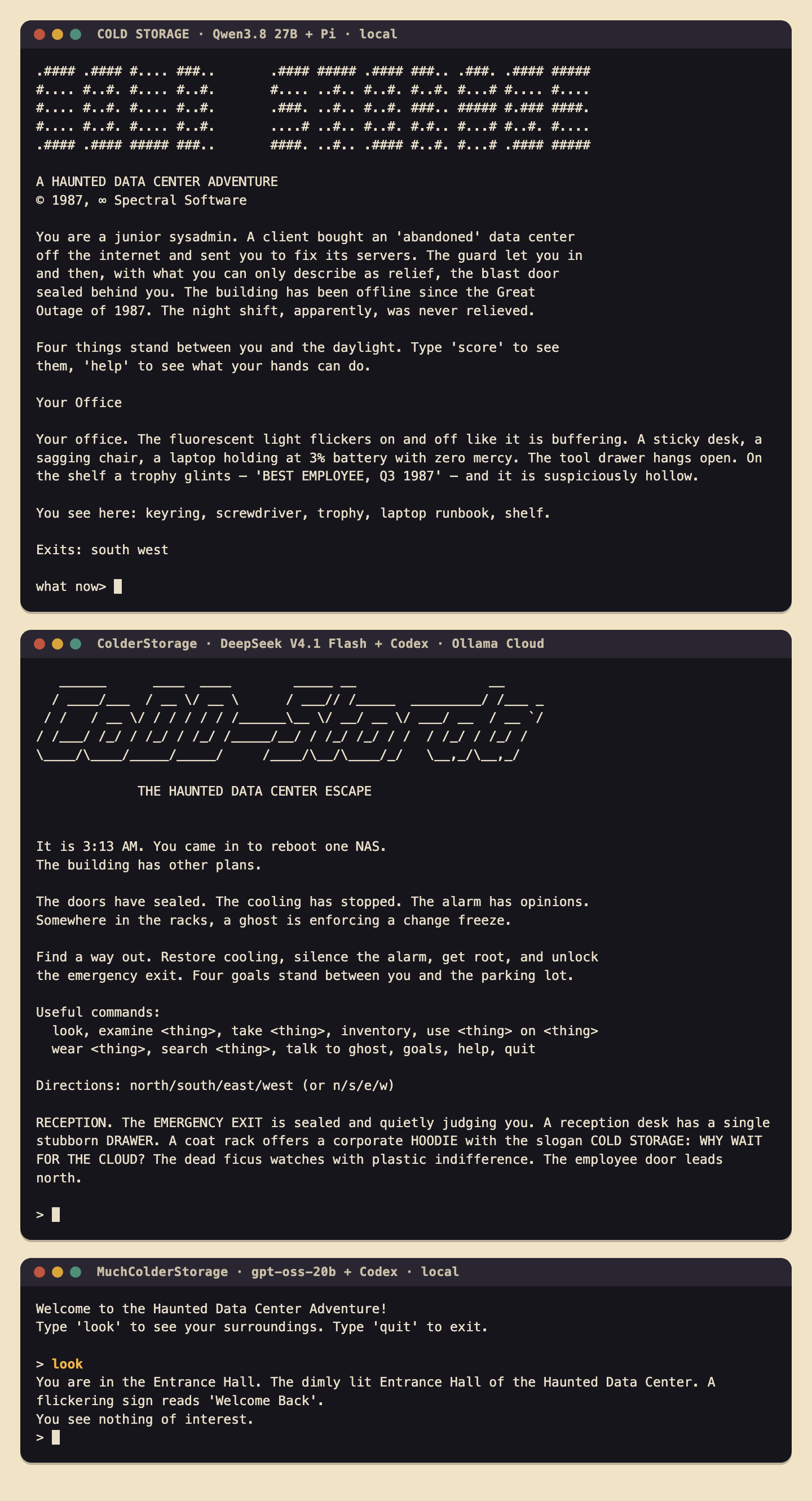
Same prompt, three opening screens, from each game’s real output.
The Qwen and DeepSeek versions both independently created a ghost sysadmin character with unfinished earthly data center business, to be completed as one of the puzzles. The Qwen model produced the longest, largest world, and arguably the funniest version, but all three versions were playable, enjoyable (in a 1980s style text adventure way), and most importantly, working code that did the job.
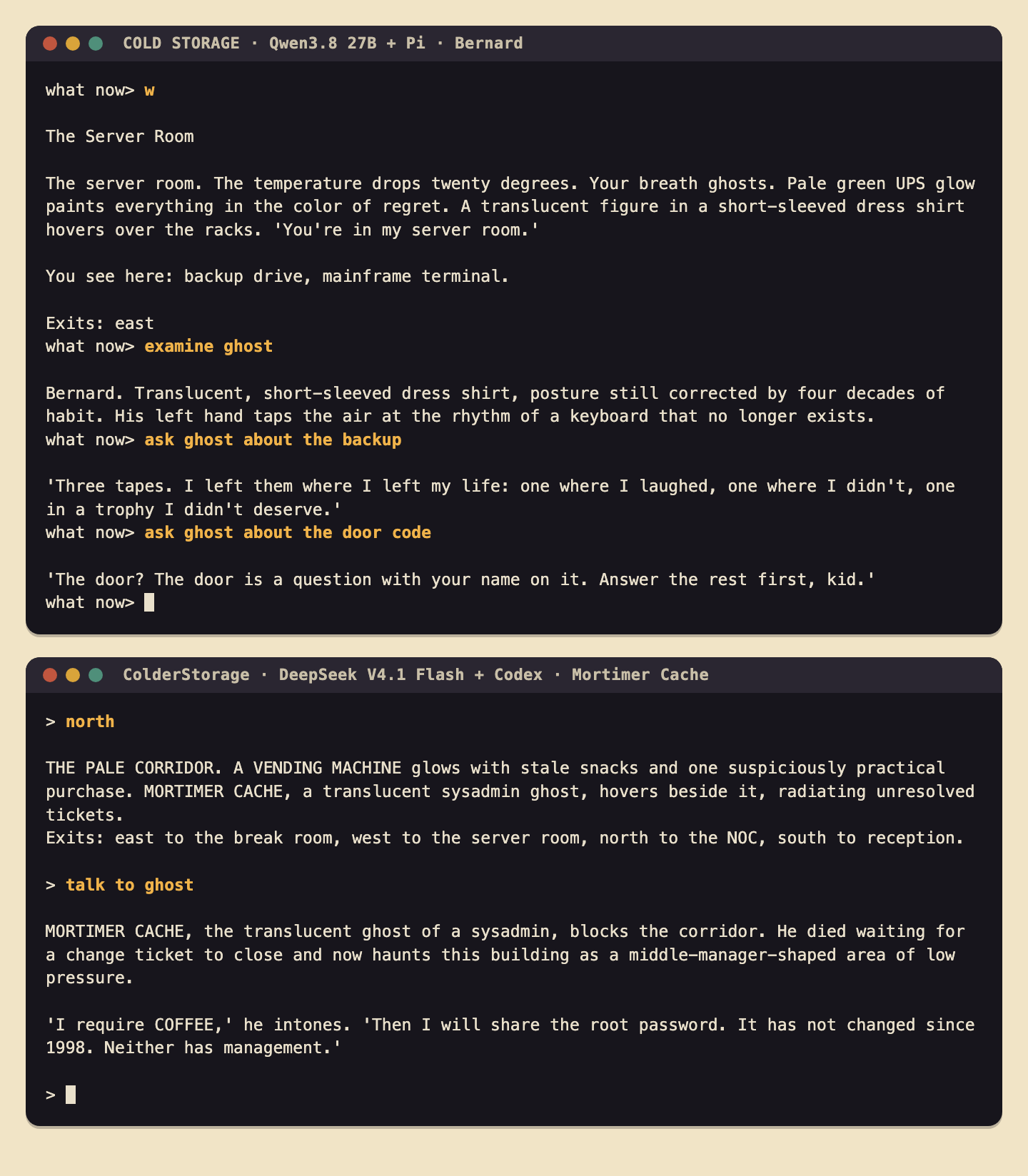
The two ghost sysadmins: Qwen’s Bernard and DeepSeek’s Mortimer Cache.
For experienced CLI-native coders, I do find the Qwen3.8 and Pi combo to be the most familiar, but for folks starting out in these adventures, Codex and gpt-oss-20b is a genuinely great way to get started with fully local AI coding and development.